With a sparkling 7-0 start, Penn State has been generating roars from the characteristically colossal home crowds all season long.
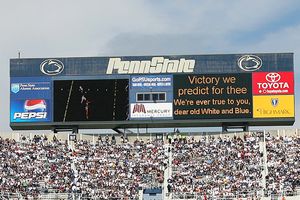
Ned Dishman/Getty Images
The lion's roar still gets fans -- and players -- pumped at Beaver Stadium.
As for genesis of
the roar, well, that's a whole 'nother Nittany Lions story.
It's the story of a pioneering stadium sound effect that purportedly predates all others, from Purdue's train whistle and Houston's air-raid siren to the feral football "copycats" at Arizona, BYU, LSU, Missouri and Northwestern. It takes place in 1968, a year freighted with great significance for Penn State football.
To Penn State partisans, the Beaver Stadium lion roar has been an enduring and energizing part of the Happy Valley football experience for four decades. As the Michigan Wolverine and their supporters will undoubtedly discover Saturday afternoon, it's also annoyed opponents and their fans for the same amount of time, causing some -- reportedly Alabama fans -- to compare it to the sound made by a high-powered toilet flushing.
Listen for yourself. According to the lion roar legend, Joe Trimarchi, a sales rep at WMAJ-AM, a State College radio station, went to his cart machine and selected a recorded lion roar as a "sounder" to preface sports news in 1967. In those days, stations had stock sound effects contained in cartridges of looping analog tape (think 8-tracks) that were housed and transported on wheeled "cart" machines.
Penn State sports information director Jim Tarman heard Trimarchi's roar and inquired about using it at PSU athletic events. The roar made its debut at a Penn State-Lehigh wrestling match later that year, migrated to Lions basketball games and, thanks to Trimarchi, to Beaver Stadium in the fall of '68.
Trimarchi, who also worked as a spotter at football games, lugged his bulky cart machine up into the press box and, by pressing a button, signaled not only the beginning of one of the most unique, yet unknown, traditions in college football but also Penn State's rise to national prominence. The lion roar would literally be heard throughout the country as Penn State embarked on its first undefeated season under a youthful head coach named Joe Paterno.
For Lions fans, the roar quickly became as essential a part of the Saturday sound track as anything played by the Blue Band. "Joe was a pretty savvy guy; he knew the appropriate times to play it," said Dean DeVore, an AccuWeather meteorologist who also works as the public-address announcer at Beaver Stadium. "There's an etiquette about it."
The signature stadium sound effect has long followed the conclusion of the Penn State drum major's famous 50-yard line flip and the team huddle after the pregame stretch, as well as Penn State first downs and touchdowns. The growl has celebrated sacks and fired up the crowd to support the defense on third downs, too.
Yet change is inevitable, even at a place as tradition-bound as Penn State. Gone are Trimarchi and his cumbersome cart machine: The father of the roar retired in 2006, and the roar has been digitized. The roar's new caretaker is sound technician Blair Drake. Drake, along with communications director Guido D'Elia, is responsible for integrating the roar and the Blue Band with new stadium standbys such as Zombie Nation's "Kernkraft 400" to create a raucous atmosphere and entertainment spectacle that DeVore calls "the greatest show on Earth."
While players, P.A. announcers, sound technicians and perhaps one day even coaches -- yes, even coaches -- will come and go at Penn State, there will always be one certainty.
"The lion roar will be here forever," said DeVore. "It's iconic."
John D. Lukacs is the consultant to College GameDay. 


0 Comments:
Post a Comment
<< Home